
In our second reading, St. Paul urges us, by the mercies of God, to present our bodies as a living sacrifice, holy and acceptable to God, which is our spiritual worship. But how do we do this? St. Paul gives us the answer: “Do not be conformed to this world, but be transformed by the renewing of your mind.”
The Christian life begins with a transformed mind. What we allow to occupy our minds eventually shapes our hearts, words, choices, and ultimately the direction of our lives. Proverbs 4:23 tells us, “Guard your heart with all vigilance, for from it flow the springs of life.” Jesus also reminds us, “Out of the abundance of the heart the mouth speaks” (Matthew 12:34).
This is precisely what we encounter in today’s Gospel. We see how a thought can become an instrument through which Satan seeks to interfere with God’s plan.
Jesus began to explain to his disciples that he must go to Jerusalem, suffer greatly, be killed, and be raised on the third day. Peter, who had just confessed Jesus to be the Messiah, could not understand what kind of Messiah Jesus would be. Peter had the right confession, but he did not yet grasp Christ’s mission. So Peter took Jesus aside and protested: “God forbid it, Lord! This must never happen to you.” But Jesus turned and said to Peter, “Get behind me, Satan!”
Notice that Jesus did not say, “Get behind me, Peter.” He said, “Get behind me, Satan.” Jesus was not condemning Peter as a person; he was rebuking the thought, the temptation, and the influence behind Peter’s words. Peter loved Jesus, but at that moment his love was being used to oppose God’s will. He wanted to protect Jesus from suffering, yet in doing so he was unknowingly opposing the very mission for which Jesus had come.
At the beginning of Jesus’ public ministry, after forty days of fasting and prayer, Satan tempted him in the wilderness. He said, in effect, “Turn these stones into bread.” In other words, use your divine power to satisfy yourself. Demonstrate your power. Give people material things, and they will follow you.
But Jesus rejected the temptation. He would not abandon the Father’s plan merely to satisfy an immediate need or to win people’s approval.
Luke tells us something significant after those temptations: “When the devil had finished every temptation, he departed from him until an opportune time” (Luke 4:13).
Note: Until an opportune time; the opportune time came as Jesus approaches the climax of his mission. The devil returns—not through an obvious temptation, but through someone who loves Jesus. Peter says, “God forbid it, Lord! This must never happen to you.”
It sounds like love. It sounds like concern. It sounds reasonable. But Jesus recognizes the temptation behind the words and rebukes it immediately: “Get behind me, Satan!”
The temptation was subtle: You are the Messiah. You cannot suffer. You cannot die. There must be another way.
But Jesus knew that the way of salvation was the way of the cross. He knew the cross was not a failure of his mission; it was the mission.
Brothers and sisters, we too must be attentive to the thoughts and voices that enter our hearts, especially in times of suffering, disappointment, fear, and uncertainty. It is often in times of turbulence that we begin to hear whispers within us:
Give up; God has abandoned you; you don’t need to pray any more; take the easy way out.
Some thoughts may seem reasonable; they may even come from people who love us. But we must learn to discern whether those thoughts lead us toward God or away from him.
This is why St. Paul urges us to renew our minds. We cannot keep every thought from entering our minds, but we can choose which thoughts we will entertain, nurture, and allow to take root.
A thought repeated often can become an attitude. An attitude can become a decision. A decision can become a habit. And a habit can shape the direction of our lives.
Guard your hearts. When a thought contradicts God’s word, confront it with faith. When fear urges us to abandon God, respond with trust. When anger urges us to seek revenge, remember Christ’s command to forgive. When suffering suggests our lives are meaningless, remember that Christ himself transformed suffering into the path of redemption.
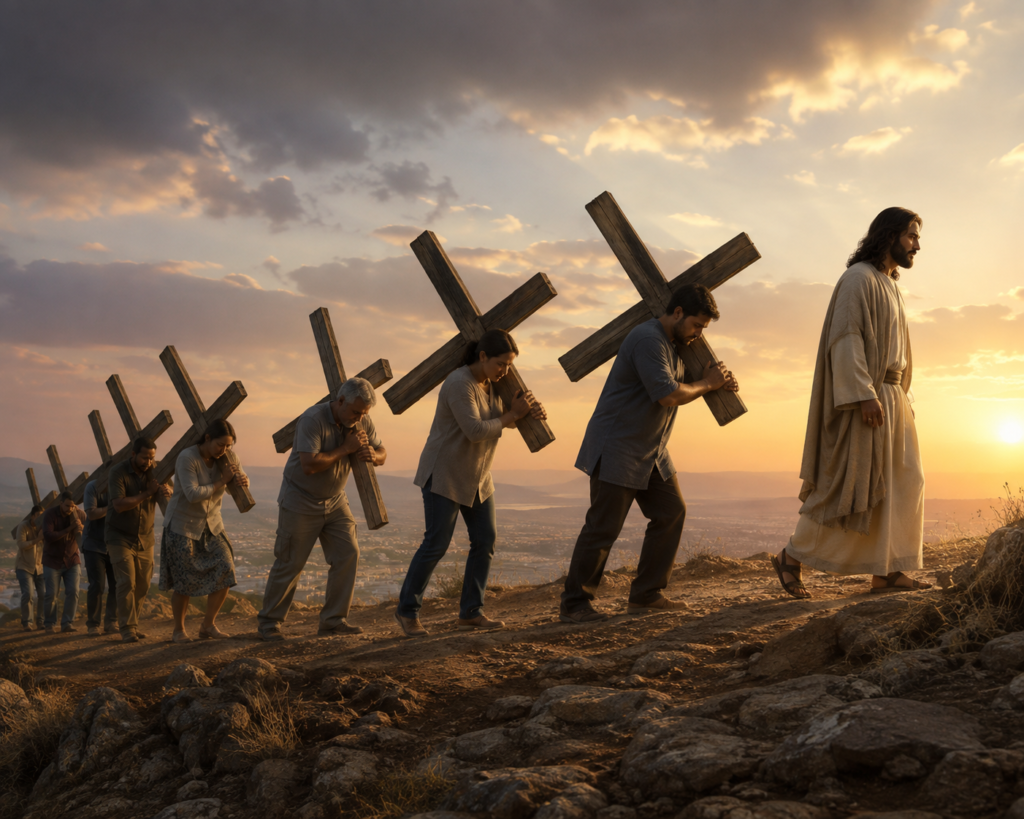
Jesus says, “If any want to become my followers, let them deny themselves, take up their cross, and follow me.” He never promised his disciples a life without suffering. He did not say, “Follow me, and you will never have problems.” Rather, he said, “Take up your cross and follow me.”
Carrying the cross, however, does not mean blindly accepting every pain, injustice, tragedy, or misfortune as if God had sent it to us. Not every suffering is something God wants for us. Some suffering comes from human sin, injustice, sickness, weakness, or the brokenness of our world.
To carry our cross means that when suffering comes, we unite our suffering with Christ’s. We bring our pain to the foot of the cross and allow Christ to give it meaning. We do not suffer alone; we suffer with Christ, trusting that the cross is not the end of the story. Beyond Good Friday comes Easter. Beyond death comes resurrection.
May God help us carry our crosses and unite them with His.