In today’s Gospel passage, Jesus comes to the district of Caesarea Philippi. This detail matters because Caesarea Philippi was a region deeply influenced by pagan religious beliefs and surrounded by shrines dedicated to various gods. In many ways, it was a place where people offered competing answers to the questions of who God was and where salvation could be found.
It is precisely in this setting that Jesus asks His disciples an important question: “Who do people say that the Son of Man is?”
The disciples give Him several answers. Some say John the Baptist, others say Elijah, and still others say Jeremiah or one of the prophets.
Then Jesus makes the question personal: “But who do you say that I am?” Simon Peter answered, “You are the Christ, the Son of the living God.”
After Peter makes his profession of faith, Jesus acknowledges that the Father revealed the truth to Peter, and then He says something remarkable: “And I tell you, you are Peter, and on this rock I will build my Church, and the gates of Hades will not prevail against it.”
This is the first time the word “Church” appears in the Bible; it comes from the Greek ekklesia, meaning an assembly or gathering of people called together. Therefore, when Jesus speaks of building His Church, He is not referring to a building made of bricks, stones, wood, or concrete. He is referring to a people.
That means that when we enter this church building, we should remember that the Church is not merely this beautiful structure around us. The Church is us—the people gathered by Christ, united in faith, worshipping God, receiving His grace, and sent into the world to proclaim the Gospel.
The Church exists because Christ called us together, and its foundation is the faith Peter professed. Therefore, our identity as Christians does not ultimately come from our nationality, profession, social status, wealth, education, or accomplishments. Our deepest identity comes from Christ.
We belong to Him. We are a people called out of darkness into light. We are a people entrusted with the Gospel and called to make Christ visible in the world.
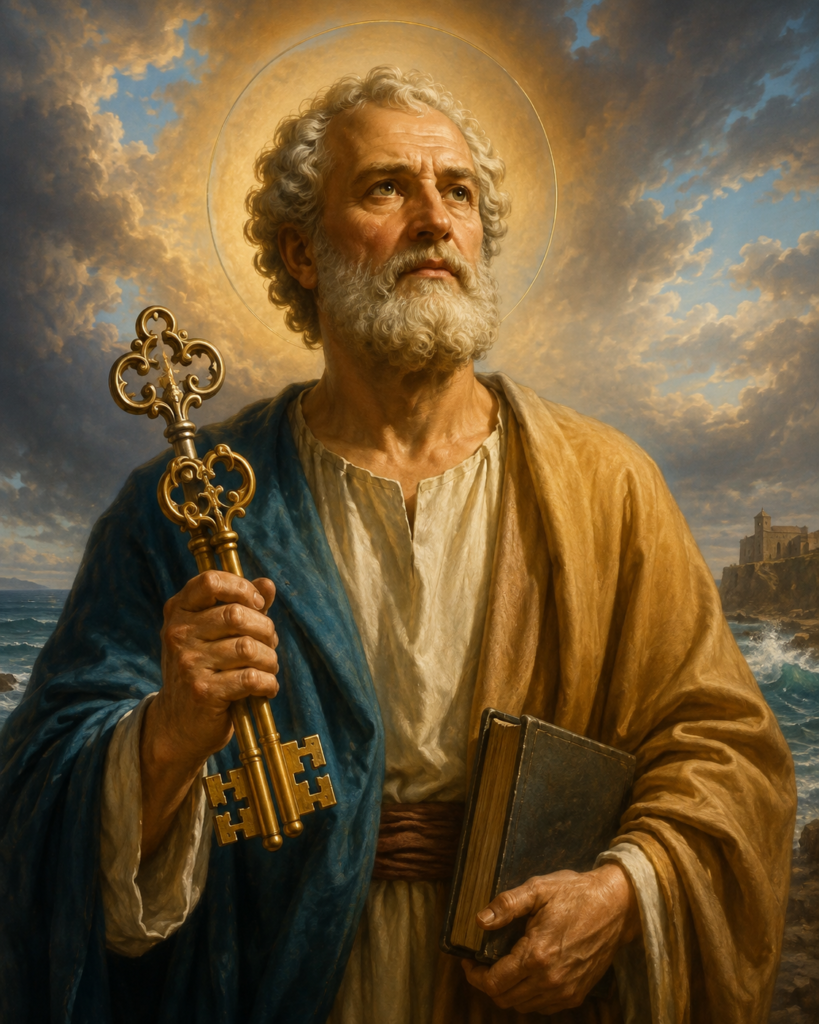
Although the Church is founded on faith in Christ, Jesus entrusts a particular responsibility to Peter. He says: “I will give you the keys of the kingdom of heaven.” The keys are given to a person. Peter is entrusted with a unique responsibility to lead, teach, guide, and serve the Church in Christ’s name. This is why, as Catholics, we recognize the particular role of Saint Peter and his successors, the Popes, in the life of the Church.
The Pope is not Christ; he does not replace Christ. Rather, the Pope serves the Church as Peter’s successor, entrusted with a particular responsibility for unity, teaching, and pastoral leadership. Therefore, our relationship with the Pope should not be reduced to loyalty to a human personality. It is part of our obedience to Christ and our commitment to the unity of the Church that Christ established.
Brothers and sisters, if we truly believe that Jesus is the Christ, the Son of the living God, that faith must change how we live. We cannot come to Mass on Sunday, profess our faith, receive the Eucharist, and then live as though Christ has no place in the rest of our lives.
Our faith must go home with us. It must enter our families, our workplaces, and our relationships. And it must influence how we speak to one another, how we treat the poor, how we forgive, how we conduct our business, how we respond to injustice, and how we treat those who disagree with us.
The world does not need Christians who merely talk about the light. It needs Christians who carry the light; who will stand for truth when lying is easier; and who will remain faithful when abandoning their faith would be easier.
Today, Jesus asks each of us the same question He posed to His disciples: “Who do you say that I am?”
As we celebrate this sacred liturgy today, let us renew our faith in Jesus Christ and the Church. Above all, let us ask for the grace to live what we profess.
Amen.