Today, the Church celebrates the Solemnity of All Saints, a beautiful and inspiring feast in which we honour all who have gone before us and now share in the glory of heaven. We honour those whose names are known to us, as well as the countless men and women whose holiness may never have been publicly recognized, yet whose lives were pleasing to God.
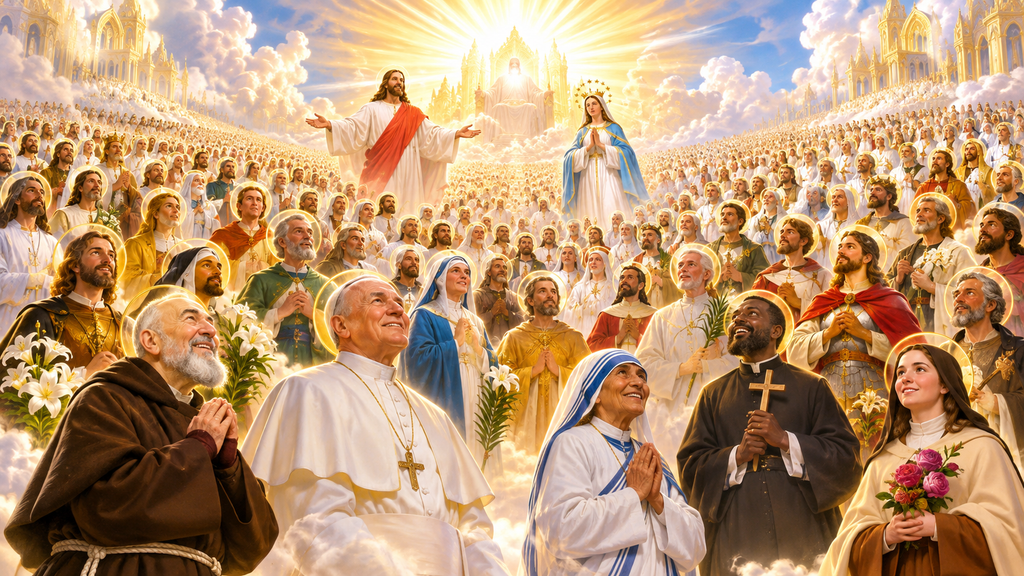
Today is not only a celebration of the saints already in heaven; it is also a celebration of hope for all of us still on our earthly pilgrimage. It is a reminder that holiness is not reserved for a privileged few; it is the calling of every Christian. God calls each of us to become a saint, to live in His grace, and to one day share in His eternal kingdom.
When we hear the word saints, many of us immediately think of extraordinary people, heavenly beings, or individuals who performed remarkable miracles and lived lives that seem far beyond our reach. We may imagine saints as people who never struggled, never experienced temptation, never made mistakes, and never had moments of weakness.
But the truth is that the saints were human beings just like us. They experienced joy and sorrow, hope and disappointment, temptation and trials. They lived in real families, worked in the world, encountered difficult people, and faced the challenges of their time. They were not made of a different substance than we are. What distinguished them was their willingness to allow God to work in their lives.
Think of saints such as Padre Pio, Saint John Paul II, Saint Teresa of Calcutta, and Saint Carlo Acutis. Some people living among us had the chance to meet them, speak with them, or even eat with them. Their lives remind us that holiness is neither an abstract idea nor an impossible dream.
The question, therefore, is not whether God wants us to become saints. He does. The real question is whether we are willing to let Him transform our lives.
In our first reading from the Book of Revelation, we are given a glorious vision of heaven. Saint John sees a great multitude, too numerous to count, from every nation, tribe, people, and language. They stand before the throne of God and the Lamb, clothed in white robes and holding palm branches.
This vision reminds us that God’s invitation to salvation is universal. His grace transcends human divisions, cultural differences, and social boundaries. What unites the saints is not their origins but their faith in God and their willingness to follow the Lamb.
Yet amid all the glory and beauty of this heavenly vision, one detail particularly strikes me. When John asks about the identity of those dressed in white, he is told: “These are they who have come out of the great ordeal; they have washed their robes and made them white in the blood of the Lamb” (Revelation 7:14).
There is a profound message hidden in these words. Why did they have to wash their robes if those robes had never been stained? Why did they need to be purified if they had never experienced the struggles and weaknesses of human life?
The image of the saints washing their robes reminds us that their journey to heaven was not necessarily without struggle. They endured great ordeals. They faced trials, temptations, suffering, and hardship. They were human beings who needed the mercy and grace of God.
The saints are not in heaven because they never needed forgiveness. They are in heaven because God’s grace was at work in them, and they responded to it with faith, repentance, love, and perseverance.
Their holiness was not a matter of human perfection but of divine transformation. They allowed Christ’s grace to cleanse, strengthen, and lead them closer to God.
The blood of the Lamb is the source of their cleansing, and the Lamb is Jesus Christ, who offered Himself on the Cross for the salvation of the world. His blood is the sign of His redeeming love, the price of our salvation, and the source of our reconciliation with the Father. Through His death and resurrection, Christ opened the way to eternal life for all who believe in Him.
This is the heart of the good news we celebrate today: our past need not determine our future, and our sins need not have the final word. The mercy of Christ is greater than our failures.
My dear friends, perhaps some of us are listening to this homily with hearts that feel burdened. Our robes, so to speak, may also be stained. Stained by sin, anger, resentment, jealousy, pride, dishonesty, or unforgiveness. They may also be stained by choices we regret, words we wish we had never spoken, or opportunities to love that we failed to embrace.
But today, the Solemnity of All Saints reminds us not to confuse our struggles with the end of our story. The same mercy that sustained the saints in heaven is offered to us.
One of the special ways we encounter this mercy is through the Sacrament of Reconciliation. In confession, we come before the Lord not to pretend we are perfect, but to acknowledge our sins and receive His forgiveness. We bring Him our stained robes, our brokenness, and our weaknesses, trusting that He can renew our hearts and restore us to His grace.
We must never be so ashamed of our sins that we refuse to seek God’s mercy. Nor should we grow so comfortable with sin that we no longer desire conversion. The Christian life requires both humility and courage: humility to acknowledge our need for God and courage to rise again whenever we fall.
May we live as saints in the making, so that one day, by the grace and mercy of God, we may be counted among the saints in heaven.
Amen.