Today, the Church celebrates the Solemnity of the Most Holy Body and Blood of Christ (Corpus Christi), a feast that honours what the Church calls “the source and summit of the Christian life.” The Eucharist is the heart of our Catholic faith. Every ministry, every sacrament, every act of charity, and every aspect of the Church’s life finds its source in the Eucharist and leads us back to it. Through this sacrament, we are united with Christ here on earth and prepared for eternal communion with Him in heaven.
In our first reading from the Book of Deuteronomy, Moses reminds the people of Israel of God’s faithful care during their forty years in the wilderness. God led them through the desert, protected them from danger, and fed them with manna from heaven when they were hungry. This miraculous bread sustained their physical lives during their journey to the Promised Land.
Yet, in today’s Gospel, Jesus reveals that the manna was only a foreshadowing of a far greater gift. He declares that He Himself is the true Bread that came down from heaven. More than that, He teaches something astonishing: “Unless you eat the flesh of the Son of Man and drink His blood, you have no life within you”. Jesus is not merely offering spiritual nourishment or symbolic food; He is offering Himself completely as the food that gives eternal life.
This teaching was controversial when Jesus first proclaimed it, and for some people, it remains controversial even today. Many Christians, including some Catholics, struggle to understand or accept the mystery of the Eucharist. The reaction of Jesus’ listeners in the synagogue at Capernaum was no different. When they heard Him speak about eating His flesh and drinking His blood, many responded by saying, “This saying is hard; who can accept it?” They found His words difficult, shocking, and even offensive.
What happened next is significant. Many of His disciples chose to leave Him and no longer follow Him. Yet Jesus did not soften His teaching or explain it away as a mere symbol. He did not run after those who left to tell them they had misunderstood Him. Instead, He turned to the Twelve Apostles and asked, “Do you also want to leave?”
This moment reveals the seriousness and truth of Christ’s teaching. If His words had been intended merely as a metaphor, this would have been the perfect opportunity to clarify His meaning. Instead, Jesus reaffirmed His teaching, and the Church has faithfully preserved that teaching throughout the centuries.
As the Catechism of the Catholic Church states: “In the most blessed sacrament of the Eucharist the body and blood, together with the soul and divinity, of our Lord Jesus Christ and, therefore, the whole Christ is truly, really, and substantially contained” (CCC 1374). This is not a doctrine invented by the Church. It is a sacrament instituted by Christ Himself.
On the night before He suffered and died, Jesus took the bread, blessed it, broke it, and gave it to His disciples, saying, “This is my body.” Then He took the cup of wine and said, “This is my blood.” He did not say, “This represents my body” or “This symbolizes my blood.” He said, “This is my body” and “This is my blood.” He then commanded His Apostles: “Do this in memory of me.” Through these words, Christ established the Eucharist and entrusted it to His Church.
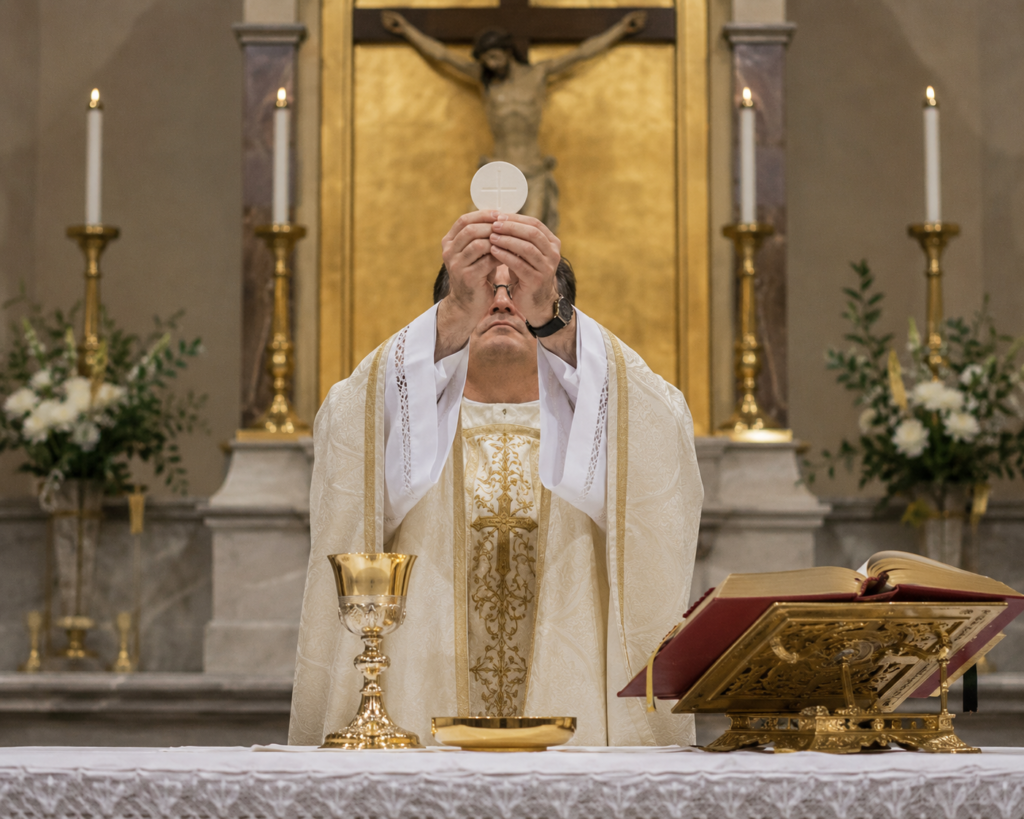
Today’s celebration is not primarily about explaining the mystery of how ordinary bread and wine become the Body and Blood of Christ. While theology helps us understand this mystery more deeply, the Eucharist ultimately remains a work of God that surpasses human understanding. Through the ministry of the priest, acting in the person of Christ, Jesus Himself transforms the bread and wine into His Body and Blood.
Rather than attempting to solve the mystery, we are invited to marvel at the depth of God’s love. The Lord of heaven and earth humbles Himself to remain with His people under the appearance of bread and wine. Just as God fed the ancient Israelites with manna in the desert, Christ continues to feed His pilgrim Church, the new Israel, with the Bread of Life on our journey toward the heavenly Promised Land.
Sadly, some Catholics have lost a sense of wonder and reverence for the Eucharist. While they may never openly deny the Real Presence, their manner of approaching Holy Communion can sometimes reveal a weakened faith in this great mystery. The Eucharist is not ordinary bread. It is not merely a symbol. It is Jesus Christ Himself—Body, Blood, Soul, and Divinity—truly present among us.
A convert to Catholicism once asked why the faithful are not always encouraged to receive from the chalice. It is important to clarify that the faithful are not forbidden from receiving the Precious Blood. The Church permits Communion under both species. However, Catholics must understand an essential truth: Christ is fully present under either species. A person who receives only the consecrated Host does not receive “half of Jesus,” nor does someone who receives only from the chalice receive less than the whole Christ. Wherever Christ is present, He is present whole.
The separate consecration of the bread and wine recalls Christ’s sacrifice on Calvary, where His Body and Blood were separated in death. Yet during the Mass, shortly before Communion, the priest places a small fragment of the consecrated Host into the chalice. This rite symbolizes the reunion of Christ’s Body and Blood and reminds us that we receive not a dead Christ, but the risen and glorified Lord who lives forever.
As we celebrate this great feast today, let us renew our faith in the Real Presence of Jesus in the Eucharist. Let us approach the altar with reverence, humility, and gratitude. Let us receive Holy Communion with hearts prepared and filled with faith, knowing that we are receiving not merely bread and wine, but Christ Himself—the Bread of Life, our Savior, and our Lord.
May our love for the Eucharist deepen each day, and may the Blessed Sacrament continue to nourish us on our pilgrimage until we share in the eternal banquet of heaven. Amen.