
In our first reading, we hear the Lord tell the prophet Elijah: “Go out and stand on the mountain before the Lord, for the Lord is about to pass by.” Elijah goes out and waits. Then something dramatic happens. A powerful, terrifying wind comes—so strong it tears through the mountains and breaks rocks. Yet the Scripture tells us that the Lord was not in the wind.
After the wind, an earthquake comes. The earth shakes beneath Elijah’s feet. Yet again, the Lord was not in the earthquake. Then a fire comes. But the Lord was not in the fire either. Finally, after all the noise, all the violence, and all the commotion, there comes “a sound of sheer silence.” And it is there that Elijah encounters God.
The experience of Elijah teaches us something very important about God: God is not always found in the spectacular, the dramatic, or the powerful. Sometimes God comes to us in silence. Sometimes His presence is hidden beneath the noise of our lives, and we must learn to listen closely enough to recognize Him.
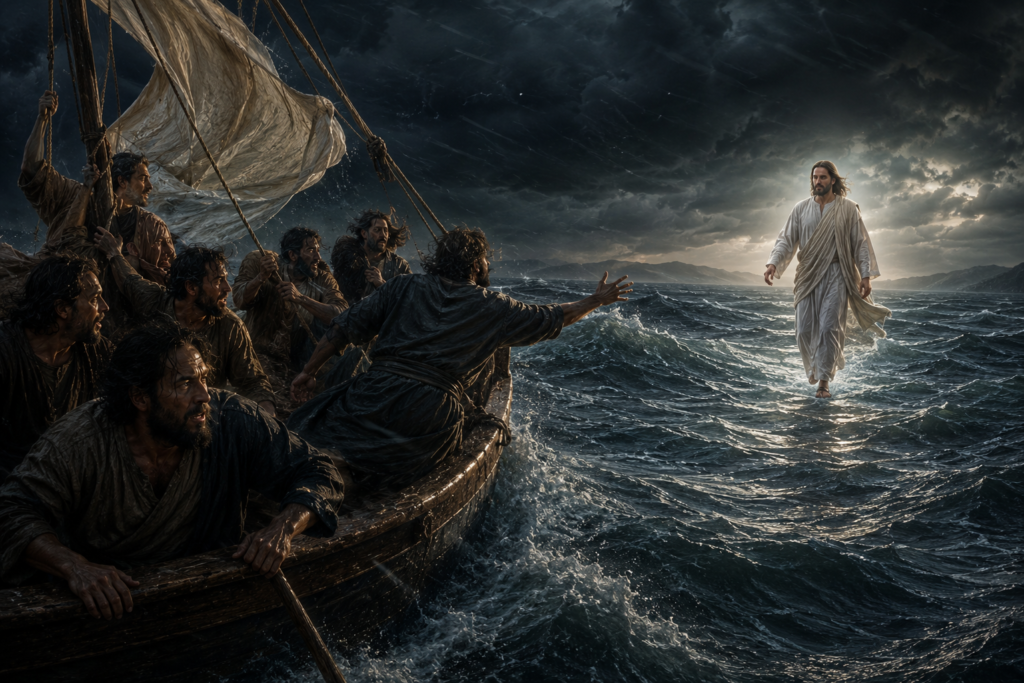
But when we come to the Gospel, we encounter another storm. This time, the storm is not on a mountain but on the sea. Matthew tells us that the disciples are in a boat, and the boat is being battered by waves because the wind is against them. They are tired, frightened, and struggling to keep the boat from being overwhelmed.
Then, in the middle of the storm, they see Jesus walking on the water. They are terrified and think He is a ghost. But Jesus speaks to them: “Take courage, it is I; do not be afraid.”
What is striking about this Gospel is that Jesus does not wait for the storm to end before coming to His disciples. He does not stand on the shore and say, “Wait until the wind dies down, and then I will come to you.” He comes to them in the midst of the storm.
When Peter sees Jesus walking on the water, he says, “Lord, if it is you, command me to come to you on the water.” Jesus simply says, “Come,” and Peter steps out of the boat.
Consider what Peter is doing. The storm has not stopped. The waves have not disappeared. The wind is still blowing. Jesus has not said, “Peter, wait until everything is calm.” He simply says, “Come.” Peter steps out of the boat and begins to walk on the water.
For a moment, Peter does the impossible. He walks where human beings cannot ordinarily walk. He participates in the power and life of Christ, and that is what Christ invites us to do.
This does not mean we should pretend our problems do not exist. Christian faith is not denial. The storm is real, the waves are real, the fear is real, and the pain is real. But the presence of Christ is also real. That is the difference faith makes. It does not necessarily remove the storm; faith enables us to recognize that we are not alone in the storm.
For some, the storm may be an illness or a difficult diagnosis. For others, it may be the pain of losing someone they love. For someone else, it may be a troubled marriage, family conflict, or a relationship that has fallen apart. For another person, it may be financial hardship, unemployment, loneliness, disappointment, failure, or uncertainty about the future.
Sometimes the storm is something no one else can see. We can smile, go to work, attend Mass, greet people, and appear perfectly fine even as a storm rages within us.
There are storms that shake our confidence. There are storms that challenge our faith. There are storms that make us ask: “Where is God”
The disciples could have asked the same questions. They were not on the sea because they had abandoned Jesus. They were there because Jesus had sent them ahead. In other words, they were in the middle of the storm while doing what Jesus had asked them to do.
Sometimes we think that if we are faithful to God, we will be protected from every storm. But Scripture does not make that promise. Faith does not mean that the wind will never blow. Faith means that when the wind blows, we know whom to trust.
When Peter looked at Jesus, he walked on the water, but when he looked at the storm, he began to sink. Perhaps someone today feels like Peter, sinking under the weight of life’s circumstances. Perhaps the storm has grown so strong that faith itself feels difficult. Cry out to the Lord, “Lord, save me.”
Sometimes we meet Him in silence, and sometimes in the storm. He comes to us through the chaos and says, “Take courage; it is I. Do not be afraid.”
The prophet Nahum tells us: “The Lord has his way in the whirlwind and in the storm.” Even in the storm you face right now, He has his way. He can calm the storm or strengthen you to work through it.
As we gather to celebrate this Eucharist, may the Lord strengthen our faith to walk through life’s storms.
Amen