Last week, when we celebrated Pentecost, I mentioned that the Holy Spirit is not merely a symbol like a dove, wind, or fire. The Holy Spirit is a person — the Third Person of the Blessed Trinity. Today, as we celebrate the Solemnity of the Most Holy Trinity, the Church invites us to reflect on the greatest mystery of our faith: one God in three Divine Persons — the Father, the Son, and the Holy Spirit.
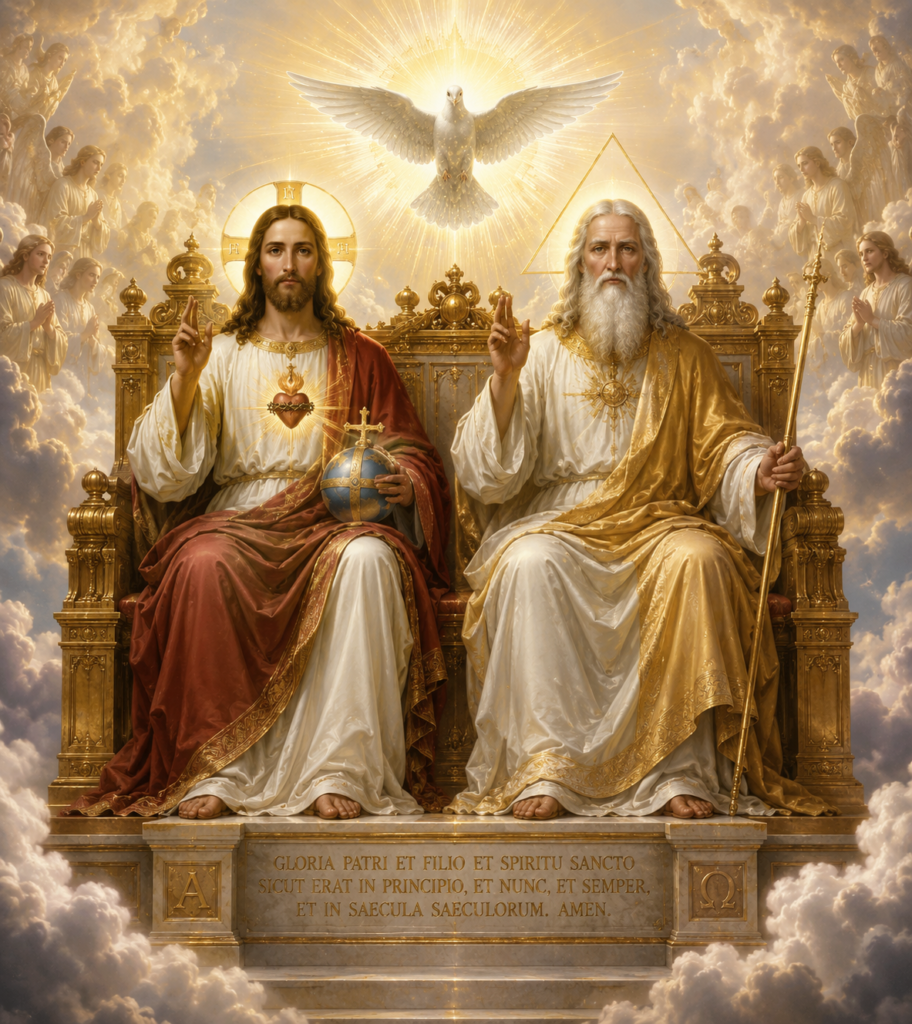
Even though the word “Trinity” is not explicitly found in the Bible, the reality of the Trinity is present throughout Sacred Scripture. One beautiful example is found in our second reading today from 2 Corinthians 13:11–13. St. Paul ends his letter with a blessing that many of us hear at Mass:
“The grace of our Lord Jesus Christ, the love of God, and the communion of the Holy Spirit
be with all of you.”
In this short blessing, Paul clearly recognizes the three Divine Persons working together as one God. The grace comes from Jesus Christ, love from the Father, and communion from the Holy Spirit. Distinct Persons, yet one divine nature.
When we speak of a “person,” we mean a complete being with intellect, will, and identity. The Father is fully God. The Son is fully God. The Holy Spirit is fully God. Yet there are not three Gods, but one God. How this mystery works is beyond the limits of human understanding. Our minds cannot fully grasp the infinite nature of God.
Even Jesus Himself spoke of this divine unity. He said, “Whoever has seen me has seen the Father,” and again, “I am in the Father and the Father is in me.” Before ascending into heaven, He commanded His disciples: “Go therefore and baptize all nations in the name of the Father, and of the Son, and of the Holy Spirit.”
Notice carefully that Jesus did not say “names” but “name” — singular. One God, yet three Persons. And the order in which they are named does not imply superiority or inferiority. The Father is not greater because He is mentioned first, nor is the Holy Spirit lesser because He is mentioned last. Rather, this order reflects how God gradually revealed Himself in salvation history: first the Father in creation and the Old Testament, then the Son in the Incarnation, and finally the Holy Spirit at Pentecost.
The Solemnity we celebrate today is not meant to solve the mystery of the Trinity as though God were a mathematical equation to be explained. Instead, it invites us into wonder, humility, and worship. Some mysteries are not meant to be conquered by the human mind but embraced by the human heart.
That is why our first reading presents Moses encountering God on the mountain. When Moses stood before the presence of God, he did not begin asking complicated philosophical questions. He did not demand explanations about God’s nature or existence. Scripture tells us that Moses quickly bowed his head to the earth and worshiped.
There are many things about God that our human minds cannot fully comprehend, yet what matters most is what God has revealed to us about His heart: that He is merciful and gracious, slow to anger, rich in kindness, and abounding in steadfast love.
The mystery of the Trinity carries an important lesson for our divided world today.
Within the Trinity, there is distinction without division, unity without confusion, equality without rivalry. The Father, Son, and Holy Spirit exist in perfect communion, perfect love, and perfect cooperation.
Today, humanity is deeply divided — by race, politics, religion, nationality, culture, ideology, and social class. People no longer see one another first as people created in the image and likeness of God. Instead, we often define people by the color of their skin, their political affiliation, their accent, their wealth, or their social status.
But the Trinity teaches us that difference does not have to lead to division. Love is possible even among persons who are distinct from one another.
The Trinity becomes, therefore, not only something we believe about God, but also a model for how we are called to live with one another — in love, communion, humility, and peace.
As Christians, we are called to reflect the life of the Trinity in our families, our communities, and our world. Wherever there is hatred, we must bring love. Wherever there is division, we must become instruments of reconciliation. Wherever there is darkness, we must carry the light of Christ.
Today, let us spend time contemplating the mystery and majesty of God. Let us stand in awe before the God who is greater than our understanding yet closer to us than we can imagine.
And as we make the Sign of the Cross — in the name of the Father, and of the Son, and of the Holy Spirit — may we remember that we are marked by the life of the Trinity and called to live in the unity of divine love.