In our first reading, the prophet Isaiah offers us a beautiful, hope-filled vision of what God has prepared for His people. He declares that on this mountain, the Lord will prepare a rich banquet for all peoples. He will remove the veil covering all nations, destroy the shroud over humanity, swallow up death forever, and wipe away tears from every face.
What a wonderful promise! Isaiah speaks of a God who does not abandon His people to suffering, sorrow, and death. He speaks of a God who sees our struggles, hears our cries, understands our pain, and prepares a future in which sorrow will give way to joy, darkness to light, and death to eternal life. From the Old Testament to the New Testament, He continually demonstrates His providence. He heard the cries of His people in Egypt and delivered them from the hands of Pharaoh. When they found themselves in the wilderness, with no reliable source of food or water, God provided manna from heaven and brought water from the rock. When their enemies threatened them, God fought for them and led them to the Promised Land.
In the New Testament, Jesus continues this same mission of divine provision. He multiplies bread for people to eat, and in Matthew 15:29–31, Jesus goes up a mountain, and great crowds come to Him, bringing the sick, the lame, the blind, and many others who are suffering. They lay them at His feet, and He heals them. The people marvel as they witness the power and compassion of God at work in their midst.
There is, however, something far deeper in Isaiah’s prophecy. The prophet does not stop at the promise of food and healing. He declares that the Lord will swallow up death forever and wipe away tears from every face.
This is more than the satisfaction of physical hunger. It is more than the healing of bodily illness. It is a promise that reaches into the deepest problem of the human condition: the reality of sin and death.
Human beings have made tremendous progress in science, medicine, technology, and other fields of knowledge. We can treat many diseases, communicate across vast distances, and accomplish what previous generations could scarcely imagine. Yet despite all our achievements, we remain unable to eliminate death from the human experience.
Death reminds us of our limitations. It separates loved ones, disrupts our plans, and confronts us with the mystery of our existence. Even when we try to avoid it, death remains a reality that every human being must face.
But Isaiah proclaims that death will not have the last word.
How will this promise be fulfilled? We find its ultimate fulfilment in Jesus Christ, who entered our human condition, suffered, died, and rose again.
On Good Friday, Jesus went up Mount Calvary, carrying His cross. Unlike the mountains where God had provided food for His people, Calvary became the place where Christ offered Himself for the salvation of the world. There, the innocent Son of God was crucified. There, He bore the weight of our sins. There, He entered the depths of human suffering and death. He swallowed up death.
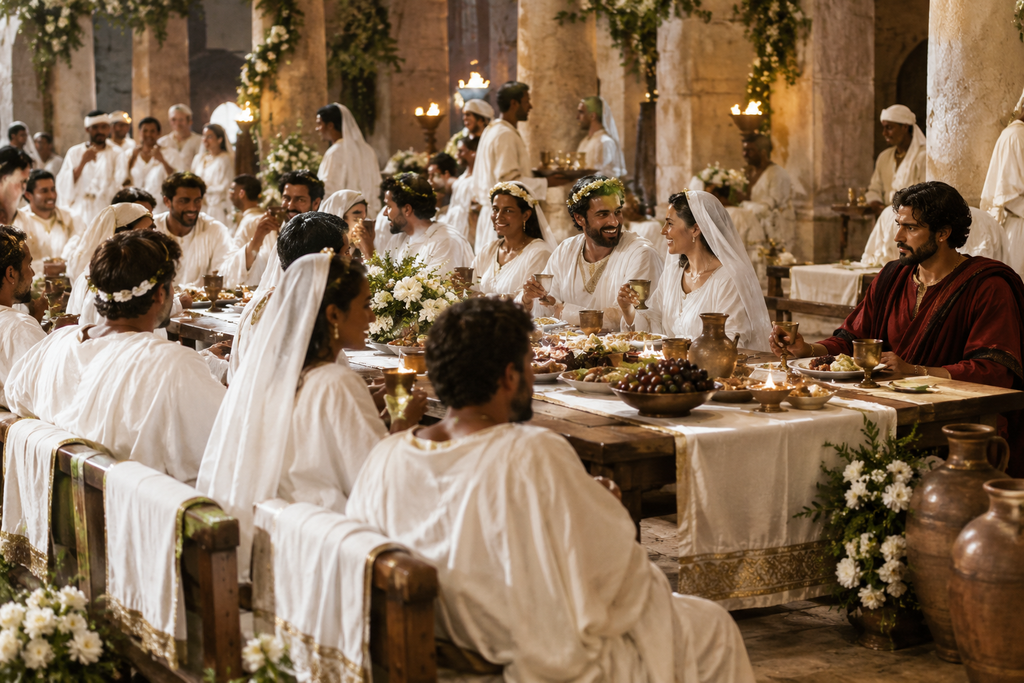
Our Gospel passage for today beautifully connects with Isaiah’s vision of the great banquet. In Isaiah, God prepares a feast for all peoples. In the Gospel, the king invites guests to his son’s wedding banquet, with the condition that they put on the wedding robe. When Jesus swallowed up death on the cross, he gave us the robe for the wedding feast, which is not merely an outward appearance of holiness. It is not simply wearing beautiful clothes to church, carrying a Bible, praying in public, or speaking religious language. Though these practices can be valuable, they cannot substitute for a heart being transformed by Christ.
We put on the robe of salvation by trusting in God and resisting the temptation to abandon our faith. It does not mean we understand everything He permits. It means believing His love is greater than our fears and that His promises endure beyond our present circumstances.
We put on the robe of salvation by forgiving those who have offended us, even though it’s not easy. Forgiving someone does not mean pretending the wrong never happened, approving of evil, or abandoning the need for justice and appropriate boundaries.
Rather, Christian forgiveness means refusing to let hatred and revenge rule our hearts. It means entrusting judgment to God while seeking, as far as possible, the freedom that comes from letting go of resentment.
We put on the robe of salvation by carrying our crosses with faith. These crosses may include disappointment, family responsibilities, the struggle to overcome sinful habits, the pain of rejection, and the sacrifices required to remain faithful to the Gospel.
Carrying our cross does not mean seeking suffering for its own sake or refusing help when it is needed. It means remaining faithful to God amid the difficulties we cannot avoid and refusing to abandon what is right simply because it costs us something.
May the Lord who has invited us to His banquet grant us the grace to put on the robe of salvation. Amen.