
The same beautiful theme runs through all three readings today: the universality of God’s grace and the salvation he offers to all people. God’s love is not limited by nationality, race, background, social status, or even by our past mistakes. God’s grace is broader than the boundaries we human beings create.
In the first reading, the prophet Isaiah speaks of foreigners—people who were not part of the Jewish people. At that time, the Jews understood themselves as God’s chosen people, and foreigners were often regarded as outsiders. Yet God speaks through Isaiah, saying to these foreigners: “If you join yourselves to the Lord, love his name, serve him, and hold fast to my covenant, I will bring you to my holy mountain and make you joyful in my house of prayer.” God even promises that their prayers and offerings will be accepted.
This is a remarkable message. God is saying, in effect, “You may be foreigners in the eyes of men, but you are not foreigners to me if you seek me with a sincere heart.”
In the second reading, St. Paul continues this reflection. The people of Israel had received a special calling and a special place in God’s plan of salvation. Yet many of them resisted the Gospel and rejected Christ. Their disobedience, mysteriously, became an opportunity for the Gentiles to encounter God’s mercy. Then, in the Gospel reading, this truth comes alive in the person of a Canaanite woman.
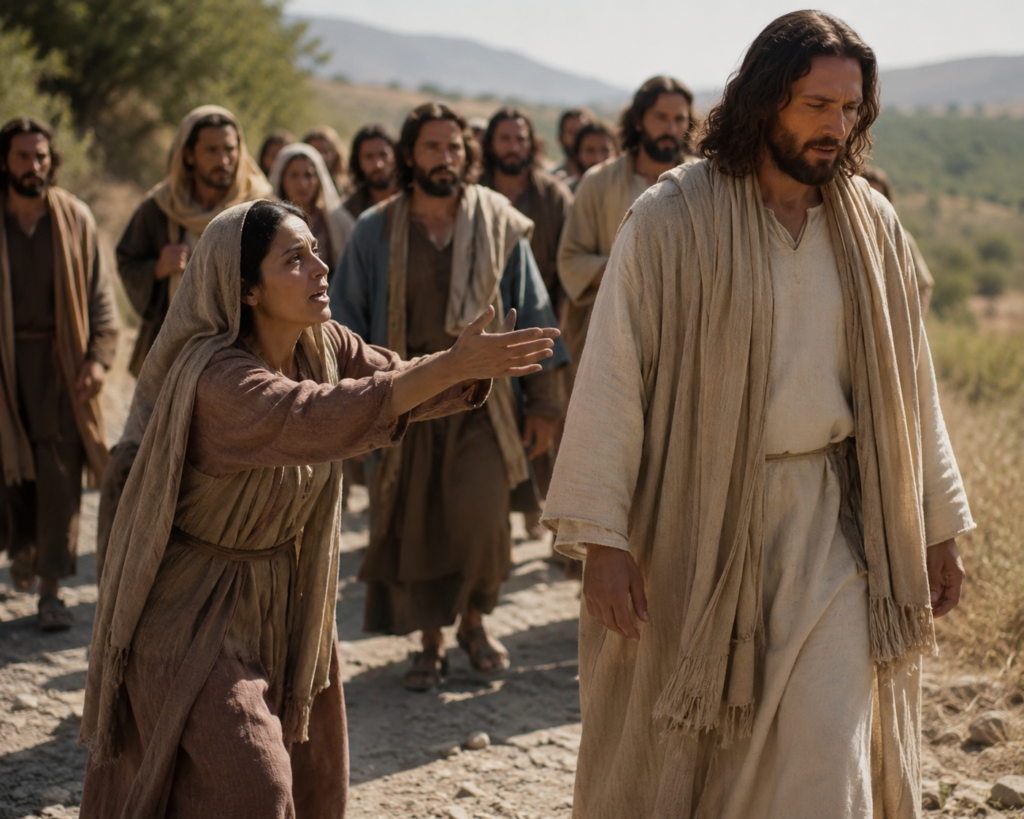
Jesus enters the region of Tyre and Sidon, Gentile territory. A Canaanite woman approaches him, crying out: “Have mercy on me, Lord, Son of David; my daughter is tormented by a demon.”
Notice the words she uses. She calls Jesus “Lord” and “Son of David.” These are not empty words. They reveal something about her faith. She recognizes something about Jesus that many of his own people were struggling to recognize. She believes he has the power to save and heal. Jesus does not immediately answer her, though. The Gospel says he was silent. The disciples grow uncomfortable with her persistent cries and say, “Send her away, because she is shouting after us.” But she refuses to leave. She continues to ask, and she continues to believe.
Jesus then says something that sounds even more difficult: “It is not fair to take the children’s food and throw it to the house dogs.”
The words are hard for us to hear because, in ordinary language, they sound like an insult. Yet the woman does not allow the apparent rejection to destroy her faith. She does not walk away angry. She does not say, “If this is how Jesus treats me, then I don’t need him.” Instead, she humbly responds: “Yes, Lord, yet even the house-dogs eat the scraps that fall from their masters’ table.”
She takes the very image Jesus has used and turns it into an expression of faith. She is essentially saying, “Lord, I am not asking you to take anything from anyone. I am only asking for a little of your mercy. Even the smallest portion of your grace is enough for me.”Jesus praises her: “Woman, you have great faith. Let it be done for you as you wish.” At that very moment, her daughter was healed.
This woman teaches us something very important about faith: faith does not always mean God answers us immediately.
Sometimes we pray, and God seems silent. Sometimes we knock, and the door does not open right away. Sometimes we ask, and instead of the answer we expected, we encounter obstacles, disappointment, or even rejection.
The Canaanite woman asked for mercy but was called a dog; she did not give up. She did not let what the Jews said about the Gentiles stop her. She probably heard the apostles tell Jesus to send her away, but she did not stop shouting for mercy. Her mind was fixed not on what others thought of her, but on what Jesus could do for her. And that is a powerful lesson for us.
Dear friends, the mercy, the love, and the grace of God can break down the barriers we sometimes create between God and us and between us and others. We sometimes let what other people say or think about us, or even what we think about ourselves, hinder our spiritual growth. Name-calling did not stop this woman, and so nothing should stop you from running towards grace and mercy.
We are sometimes tempted to spend too much time listening to the voices around us and too little time listening to God.
People may define you by your past, but God sees your future. People may remember your failures, but God sees the possibility of conversion. People may exclude you, but God can welcome you. For God’s grace is greater than our boundaries, his mercy is greater than our failures, and his love is greater than anything that could ever separate us from him.
May we continually trust in God’s grace and mercy.
Amen.