Pentecost, for many Christians today, is immediately associated with the coming of the Holy Spirit, which is not wrong. Originally, Pentecost was not a Christian feast at all. It was one of the three great pilgrimage feasts of the Jewish people: Passover, Pentecost, and Tabernacles. These feasts were deeply woven into the spiritual and cultural life of Israel.
Passover commemorates God’s mighty deliverance of the Israelites from slavery in Egypt through the sacrifice of the Passover lamb. Pentecost, also known as the Feast of Weeks, was celebrated fifty days after Passover as a thanksgiving feast for the wheat harvest. The Feast of Tabernacles remembered Israel’s journey through the wilderness when the people lived in temporary shelters while God led them toward the Promised Land.
These feasts were so important that Jews travelled from many regions of the world to Jerusalem in obedience to God’s command. That is why, on the day of Pentecost described in the Acts of the Apostles, Jerusalem was overflowing with pilgrims from every direction. Scripture tells us there were Parthians, Medes, Elamites, residents of Mesopotamia, Judea, Cappadocia, Pontus, Asia, Phrygia, Pamphylia, Egypt, Libya, and even visitors from Rome. They had not come because they were expecting the Holy Spirit. They had gathered for a religious and cultural celebration of thanksgiving for the harvest.
Yet behind what appeared to be an ordinary feast, God was orchestrating something extraordinary, just like in some ordinary events in our lives, God orchestrates something extraordinary
This gathering of people reminds us of another gathering in the Gospel of Luke 5:1–6. Simon Peter and his companions had labored all night and caught nothing. Then Jesus instructed Simon to launch into the deep and cast down the nets again. Humanly speaking, it made no sense, but Simon obeyed. Suddenly, there was such an abundance of fish that the nets began to break. One may imagine that the Lord Himself had summoned the fish into that place.
In the same way, the crowd gathered in Jerusalem on Pentecost was not accidental. God, in His divine providence, gathered people from many nations into one city at the exact moment He intended to pour out His Spirit. The people thought they had come for a harvest feast, but God had prepared them for a spiritual harvest. And Peter, who once caught fish at the command of Christ, now stood ready to catch souls for the Kingdom of God. Jesus had told him, “From now on you will be catching men,” and on Pentecost that prophecy was fulfilled.
Before the coming of the Holy Spirit, however, the apostles were fearful and intimidated. After the crucifixion of Jesus, they locked themselves in a room, afraid of the Jewish authorities. The men who had once walked boldly with Jesus had become timid and uncertain. But everything changed when the Holy Spirit descended upon them.
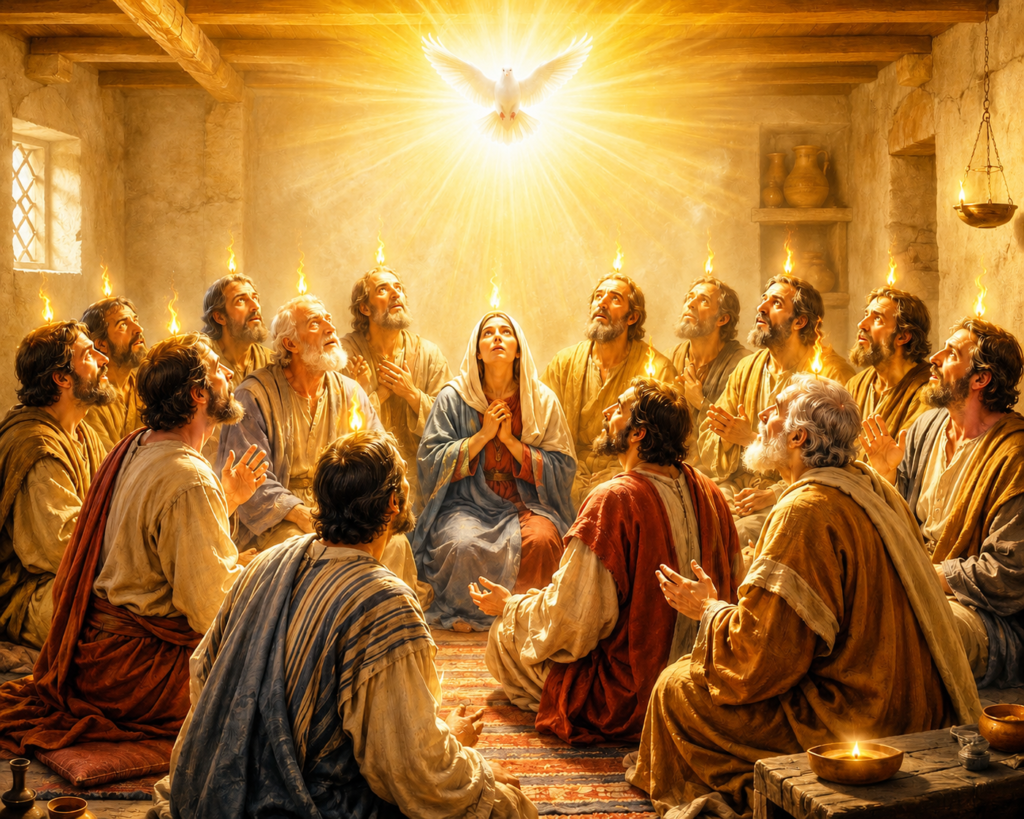
The sound of a mighty rushing wind filled the house. Tongues as of fire rested upon them. They were filled with the Holy Spirit, and suddenly fear gave way to courage, confusion gave way to clarity, and weakness gave way to power. Peter, who had once denied Jesus before a servant girl, now stood publicly before thousands proclaiming Christ crucified and risen. On that day, the Church was born, empowered, and sent into the world.
And that same Church still lives today. We are that Church. And the same Holy Spirit who transformed the apostles continues to work in us and through us. Sadly, many Christians today live spiritually intimidated lives—not because the Holy Spirit has abandoned the Church, but because many no longer recognize His presence or understand who He truly is.
The Holy Spirit is not merely a symbol. He is not simply a dove. He is not merely wind, fire, or an impersonal force. The Holy Spirit is a Divine Person—the Third Person of the Holy Trinity. He is equal with the Father and the Son in majesty, glory, and power. He is called the third person not because He is lesser, but because of the order in which He is revealed to us in Scripture.
The Holy Spirit is God dwelling within us. He is the presence of God in the believer. He teaches, guides, convicts, comforts, strengthens, and empowers. He gives wisdom in moments of confusion, courage in moments of fear, and perseverance in moments of weakness. The Spirit who emboldened the apostles is the same Spirit at work in the Church today.
Therefore, Pentecost is not merely a remembrance of a past event; it is an invitation to a present experience. God still desires to fill His people with the Holy Spirit. He still desires to transform fearful disciples into courageous witnesses. He still desires to gather people into His Kingdom through the preaching of the Gospel.
So, as the apostles surrendered themselves to the power and guidance of the Holy Spirit, so must we. In our moments of weakness, uncertainty, fear, and discouragement, we must open our hearts to Him. When we yield to the promptings of the Holy Spirit, He shapes us into faithful witnesses of Christ and empowers us to live for the glory of God.
It is my prayer that the same Spirit who descended at Pentecost renew our hearts, strengthen our faith, and set us on fire once again for the mission of Christ. Amen.