We live in a time when getting lost feels almost impossible. With navigation apps guiding our every turn, we simply speak a destination and follow the voice. Yet, even with such precision, we’ve all experienced those moments when the route takes us in circles—arriving eventually, but not without confusion, delay, or detours. It’s a small reminder that knowing about the way is not always the same as truly knowing the way.
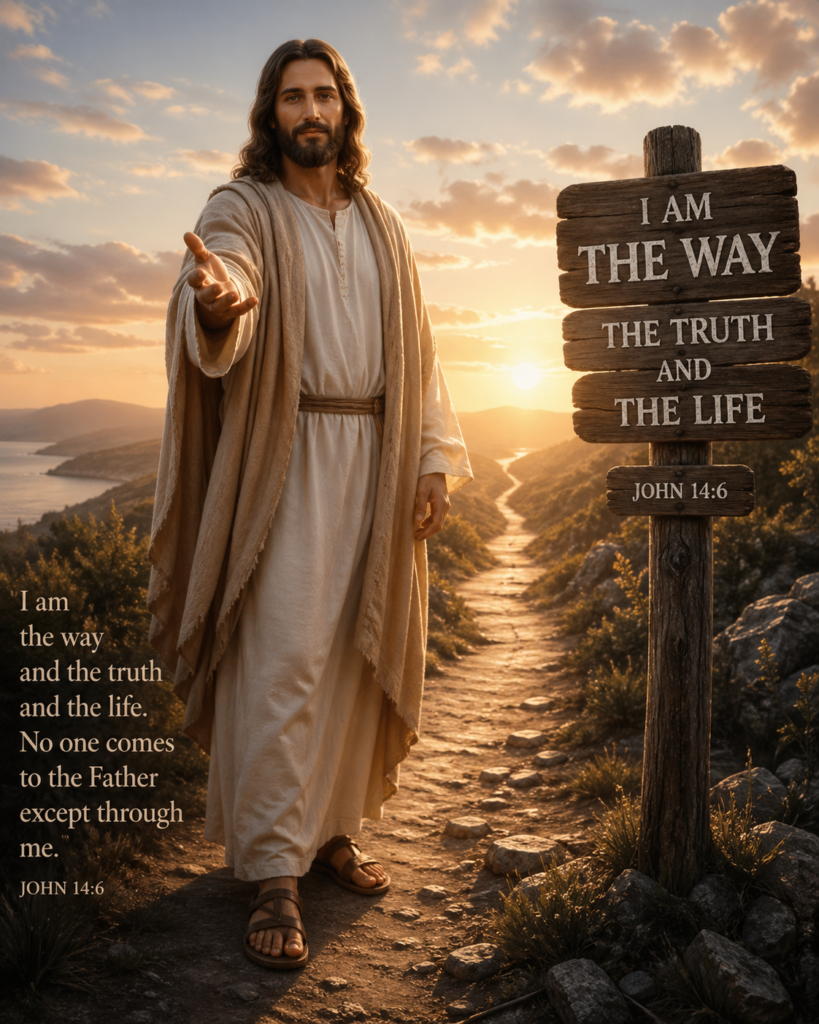
This image helps us enter into today’s Gospel, drawn from the Gospel of John. Jesus is speaking to His disciples on the eve of His Passion. He has just told them something deeply unsettling—that where He is going, they cannot yet follow. Their hearts are troubled. They have left everything for Him, and now He speaks of departure. But immediately, He offers consolation: “In my Father’s house there are many dwelling places… I go to prepare a place for you.”
Then comes that striking statement: “You know the way to the place where I am going.” And it is Thomas the Apostle who voices what the others are likely thinking: “Lord, we do not know where you are going. How can we know the way?”
It’s an honest question. It’s also our question. We want clarity, directions, certainty—a spiritual GPS that lays out every step, every turn, every possible obstacle. But Jesus does not respond with a map. He does not give a set of coordinates or alternative routes. Instead, He gives something far more demanding—and far more profound: “I am the way, and the truth, and the life. No one comes to the Father except through me.”
Notice this carefully: Jesus does not point to the way; He is the Way. That changes everything. It means that Christianity is not merely about following instructions or selecting preferred teachings. It is about a relationship—walking with a Person. We cannot take parts of Christ that are comfortable and ignore those that challenge us. The Way is not customizable. It is not a route we design; it is a life we receive.
And yes, this Way can feel difficult. It can seem winding, even confusing at times. There are moments when faith feels like it is leading us through unexpected turns or long stretches of waiting. But the assurance we hold onto is this: the Way we walk is not arbitrary. It is grounded in Christ Himself—the one whom Scripture calls the cornerstone, even though He was rejected by some. In Him, we are being built into something living, something eternal.
Then we encounter another voice in the Gospel—Philip the Apostle—who expresses a different kind of impatience: “Lord, show us the Father, and we will be satisfied.” In other words, “Why the journey? Why the process? Just give us the destination.”
That desire is deeply human. We often want quick answers, immediate clarity, and instant fulfilment. But Jesus gently corrects this misunderstanding: “Whoever has seen me has seen the Father… I am in the Father and the Father is in me.”
Here lies a deep truth: Jesus is not only the Way to the destination—He is the destination. To encounter Him is to encounter the Father. To know Him is to enter into divine life. The journey and the goal are united in Him.
This is not just theology; it is an invitation. An invitation to a relationship—to truly embrace the Father in Christ. Not as an abstract idea, but as a living reality that shapes how we pray, how we trust, and how we live each day.
And perhaps the most comforting image of all is found in the parable of the Prodigal Son. Like that son, we often wander. We chase illusions and find ourselves far from where we ought to be. We may even feel that the journey back is long and uncertain.
But the good news of the Gospel is this: in Christ, the distance collapses. The Father does not wait passively at the end of a long road. He runs toward us. In Jesus—the Way, the Truth, and the Life—the Father comes out to meet us, to embrace us, to restore us.
So the question is not whether we have the perfect directions. The question is whether we are willing to walk with Christ, to trust Him even when the road feels unclear, and to remain in Him when the journey becomes difficult.
Because in the end, the Way is not a path we master—it is a Person who leads us home.