
I am often surprised that many people in Jesus’ time struggled to understand Him when He spoke about the sheepfold. It was not an unfamiliar image to them; rather, it was part of their daily life. The sheepfold was a common structure in their culture—a protected enclosure where sheep were kept, especially at night, to guard them from predators and thieves. It usually had only one entrance, carefully watched over by a gatekeeper.
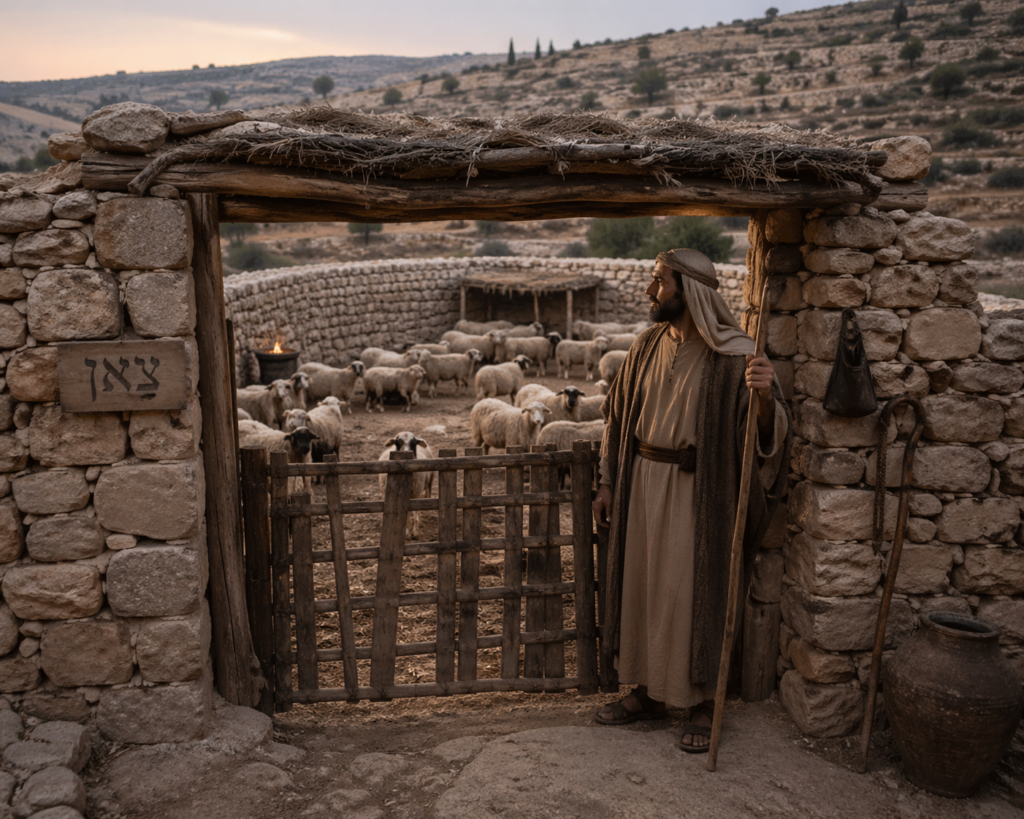
In many villages, the sheepfold was even shared. Several shepherds would bring their flocks into the same enclosure for safety overnight. In the morning, each shepherd would arrive, call out to his sheep, and they would respond to his familiar voice. The sheep would not follow a stranger. They had learned to recognize the voice of their own shepherd and trusted it above all others.
This simple but powerful Palestinian image becomes a profound teaching when we apply it to our spiritual lives.
The world we live in today can be seen as a kind of sheepfold. Just as different shepherds come into the sheepfold to call their sheep, so also in our world, many voices are constantly speaking, calling, and competing for our attention. There are voices everywhere—on our screens, in our conversations, in cultural trends, and even in our inner thoughts. Each voice claims authority, each voice seeks to guide us, and each one demands to be followed.
But the danger is this: anyone who does not know the voice of the true Shepherd will eventually be misled.
Some of these voices are loud and persuasive. They attempt to convince us that faith in God is outdated, irrelevant, or unnecessary for modern life. Others present a form of Christianity without the cross—a comfortable religion without sacrifice, without repentance, and without transformation. In such voices, truth becomes relative, morality becomes flexible, and Scripture is reduced to nothing more than ancient literature with no binding authority.
These are the voices Jesus warned about—those who do not enter through the gate but climb in by another way. He Himself declares, “I am the gate of the sheepfold.” Any voice that bypasses Him, distorts Him, or replaces Him is not leading us to life. Instead, such voices steal hope, kill faith, and destroy purpose.
Yet, in the midst of this confusion, there remains another voice—the voice of truth, the voice of the Gospel, the voice of Christ.
We see this clearly in the Resurrection account. When Mary Magdalene encountered the risen Jesus, she did not recognize Him at first. In her sorrow, she mistook Him for the gardener. But everything changed the moment He spoke her name. At the sound of His voice, recognition broke through her confusion. She turned and exclaimed, Rabboni!—Teacher.
In the same way, in the first reading from the Acts of the Apostles, when Peter raised his voice on the day of Pentecost, he did not speak with human persuasion alone, but with the power of the Holy Spirit. He proclaimed the truth of Christ crucified and risen, and the hearts of those who listened were deeply moved. About three thousand people were “cut to the heart.” They recognized the voice of truth, responded in faith, and were baptized.
What made the difference in both cases? Familiarity with God’s voice and attentiveness to His Word. Mary knew Jesus because she had walked with Him. The early believers responded because they opened their hearts to the message being proclaimed.
This leads us to a personal question we cannot avoid: Do I know His voice? Can I recognize the voice of truth when it speaks to me? And even more practically: which voices are shaping my life?
Are we listening to the voice that constantly reminds us of our weaknesses, our failures, and our sins without hope of forgiveness? Are we listening to the voice of condemnation that tells us we are beyond redemption?
Or are we listening to the voice of the Good Shepherd—the voice that calls us to mercy, to healing, to repentance, and to new life? The voice that does not deny our sins but offers grace greater than our sins?
Today, the Lord gently reminds us that He is the Good Shepherd. He is the Way, the Truth, and the Life. His voice does not confuse; it clarifies. It does not condemn; it calls us home. It does not destroy; it restores.
The invitation, then, is simple but profound: learn to recognize His voice. Spend time with Him. Listen to His Word. Follow Him closely. Because in a world filled with many competing voices, only the voice of the Good Shepherd leads us safely home.