
One of the most common objections raised against devotion to the Blessed Virgin Mary is the claim that Catholics “worship” her. While this accusation is often based on misunderstanding, simply dismissing it without explanation does a disservice—not only to those who genuinely seek clarity, but also to the Church itself. Our faith deserves to be explained, not merely defended with a laugh.
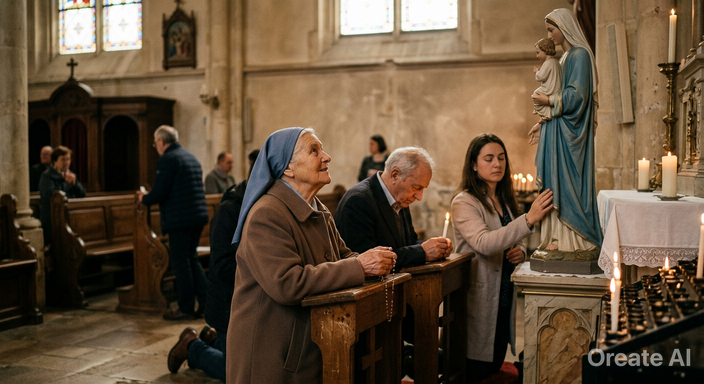
First and foremost, Catholics do not worship the Blessed Virgin Mary. The Catholic Church has never taught such a thing. Worship—understood as the highest form of adoration and absolute devotion—is reserved for God alone. It belongs exclusively to the Creator, the One from whom all things come and to whom all things return. There is no being equal to God, and no creature, however holy, can ever receive that level of honour.
What we give to the Blessed Virgin Mary is something entirely different: veneration. Veneration is a form of deep respect and honour, but it is not worship. It is similar, in a limited sense, to the admiration we might have for a hero or a role model—but elevated into a sacred and spiritual context. The Blessed Virgin Mary is honoured not because she is divine, but because of her unique role in God’s plan of salvation.
And truly, who would not honour the Mother of Jesus Christ? Who would not honour the one whom God Himself chose and favoured in an unparalleled way? Scripture itself shows us that honouring the Blessed Virgin Mary is not a human invention but a response to God’s own action. The angel Gabriel greets her with reverence, and Elizabeth, filled with the Holy Spirit, calls her blessed among women (Luke 1:41–42). In honouring the Blessed Virgin Mary, we are echoing the honour that God first gave her.
Furthermore, when Catholics ask the Blessed Virgin Mary to intercede for them, they are simply doing what Christians have always done—asking others to pray for them. We ask friends, family members, and fellow believers for prayers every day. Why, then, should it be strange to ask the Mother of Jesus to pray for us? If the prayers of a righteous person are powerful, how much more the prayers of the one who was closest to Christ?
Another common objection is that the Blessed Virgin Mary is “dead,” and therefore unable to hear or respond to our request. But this raises a deeper question: what is death in the light of Christ? Did Jesus not conquer death? Did He not rise from the grave and promise eternal life to those who belong to Him?
Jesus Himself teaches us that God “is not the God of the dead, but of the living” (Matthew 22:31–32). He refers to Abraham, Isaac, and Jacob—men who had physically died long before—yet speaks of them as living. This reveals a profound truth: those who are with God are alive in Him. Death is not annihilation; it is a passage into eternal life.
Therefore, since the Blessed Virgin Mary is with God in heaven—as Catholics believe of all the faithful who have gone before us—then she is alive in the fullest sense. And being alive in God’s presence, she can intercede for us.
In the end, devotion to the Blessed Virgin Mary does not take anything away from God; rather, it leads us closer to Him. We do not worship her—we honour her. We do not give her God’s glory—we recognize the greatness of what God has done in her. And in asking for her prayers, we participate in the beautiful communion of believers united in Christ, both on earth and in heaven.