In the year 2000, Pope John Paul II formally established a new feast in the Catholic Church: Divine Mercy Sunday, first celebrated in 2001 on the Second Sunday of Easter—this very day. This feast finds its origin in the profound spiritual experiences and apparitions received by Saint Faustina Kowalska, through whom the message of God’s boundless mercy was powerfully renewed for the modern world.

Although the Feast of Divine Mercy may seem recent when compared to the long and rich history of the Church, the reality it celebrates is as ancient as creation itself. Divine Mercy is not new—God has always been merciful. From the very beginning, even in the Book of Genesis, we see this clearly. When Adam and Eve sinned and became aware of their nakedness, they hid in shame and tried to cover themselves with leaves. Yet God, in His justice, did not abandon them; instead, in His mercy, He clothed them properly and promised redemption. Justice did not cancel mercy—rather, mercy fulfilled and ‘surpassed’ justice.
This same divine pattern is revealed again in today’s Gospel. After the suffering and death of Jesus, His apostles—out of fear—abandoned Him and fled. They failed Him in His darkest hour. Yet after the Resurrection, Jesus Christ did not return to rebuke or condemn them. Instead, He came bearing a message of peace: “Peace be with you.” These were not words of reproach, but of reconciliation. He offered them forgiveness, restored their dignity, and entrusted them with a mission—not just for themselves, but for the whole world.
In a deeply symbolic and powerful gesture, Jesus breathed on them and said, “Receive the Holy Spirit. Whose sins you forgive are forgiven them, and whose sins you retain are retained.” In this moment, we see a beautiful echo of creation itself. Just as God breathed life into humanity in the beginning, so now Christ breathes new life into His apostles. The life that was wounded and diminished by sin is now restored—and even more, a means is given for its continual renewal: the Sacrament of Reconciliation, the living fountain of Divine Mercy.
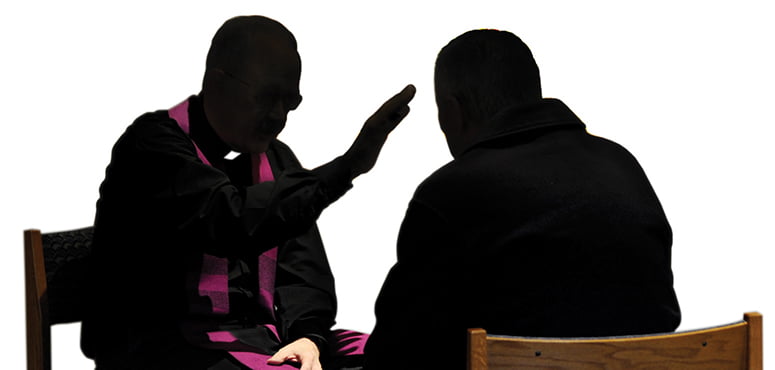
This sacrament is one of God’s greatest gifts to His Church. Yet many people—even faithful Catholics—struggle with it. Some ask: why must I confess my sins to a priest? Why not go directly to God? These are honest questions. But we must remember that while the apostles were indeed human and imperfect, Christ Himself entrusted them with divine authority. “Whose sins you forgive are forgiven.” This authority did not end with them; it has been passed down through the generations by the laying on of hands in priestly ordination.
A validly ordained priest does not forgive sins in his own name, but in the name of the Father, and of the Son, and of the Holy Spirit. The effectiveness of the sacrament does not depend on the personal holiness of the priest, but on the power of Christ who acts through him. While a priest, like all of us, is called to holiness and must seek God’s mercy for his own sins, his human weakness does not cancel the grace God offers through the sacraments.
Today, on this Divine Mercy Sunday, the Church invites us to rediscover and embrace this incredible gift. God’s mercy is not distant or abstract—it is real, personal, and available to each of us. No sin is too great, no failure too final. The risen Christ stands before us, just as He stood before His apostles, offering peace, forgiveness, and a new beginning.
The question is not whether God is willing to forgive—but whether we are willing to trust in His mercy, to turn back to Him, and to receive the grace He so freely offers.